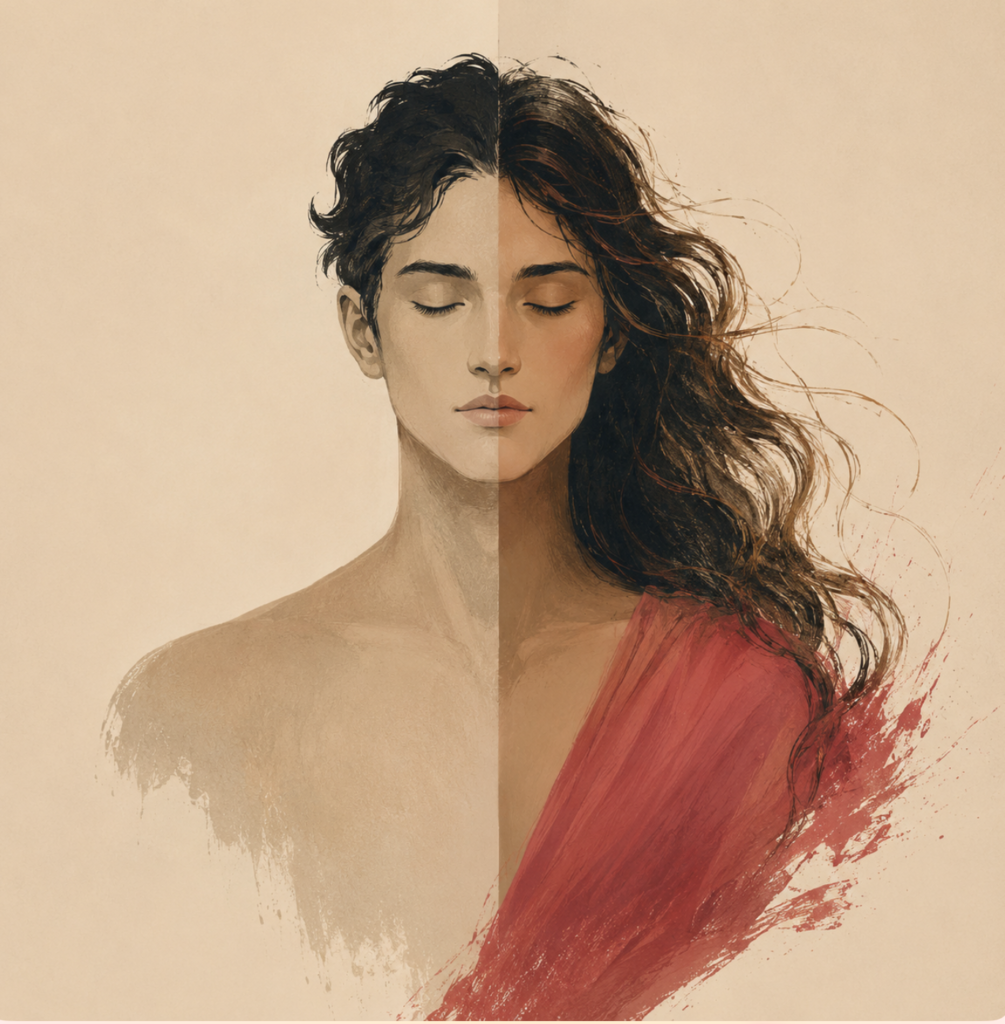
What happens when two people both need safety and wilderness (aliveness), but access them through opposite pathways?
I explore the tension between these two basic human needs present in all of us, individually and in relationships. And most relational suffering does not come from lack of love, but from fragmented attempts to protect vital human needs.
I will intentionally not reduce this article to attachment labels: anxious/avoidance, or to man/woman fixed dynamics, as I feel that, while it can explain behaviour, it does not fully touch on our soul longings, our existential needs or life force expression.
It is important to mention that one principle is not more evolved or better than another. In their healthy form, both are essential expressions of life. Safety in its pure form is groundedness, trust, nervous system relaxation, belonging, surrender. Freedom in its pure form is aliveness, movement, exploration, spontaneity, expansion, self expression, play, creativity. The fragmentation begins when one principle becomes disconnected from the other. Neither is higher. Neither is lower. A whole human being needs both.
The freedom principle, if it is disconnected from coherence and relational responsibility can become chaotic, dispersed and scattered.
The safety principle, if it is disconnected from aliveness, movement and individuality can become rigid, controlling, contracted and more interested in preserving than living.
And yes… relationships often expose these fragmentations very intensely, because relationships activate the places where our inner union is not yet stable.
In the relationship dynamics, what interests me most is exploring what happens when two valid needs stop being able to remain in dialogue and begin crystallising into defended identities and what is the individual and relational healing journey, how to nervous systems can learn to relate instead of react.
Individual Inner Union
If we tend to lean more towards one pole or another, it is important that we cultivate within ourselves the other dimension: if we crave safety, we can learn how to be more wild and if we value freedom above all, we can learn to cultivate groundedness, coherence, and relational anchoring.
Also, safety cannot come only from external certainty and freedom cannot come only from external absence of limits… It is our responsibility to cultivate within ourselves both energies.
In Hinduism, Ardhanarishvara is a Hindu form where Shiva and Shakti are represented as one being: half masculine, half feminine. Shiva is consciousness and Shakti is energy.
Psychologically and spiritually, the symbolism is much deeper than gender. It represents: integration of opposites, coexistence without domination, consciousness and life-force in balance, structure and flow, stillness and movement, containment and aliveness. In this context, integration between containment and aliveness, safety and freedom.
Shakti represents life-force: eros, movement, creativity, aliveness, freedom, expression.
Shiva represents consciousness: coherence, containment, presence, direction, devotion.
Shakti without consciousness can become chaotic, impulsive, overwhelming, fragmented life-force. And consciousness without Shakti becomes lifeless, emotionally dead, disconnected from aliveness and static. And life requires both: directed consciousness and living energy.
Inner union begins when both principles start becoming available internally.
Fragmentation
Fragmentation is the consequence of failed inner union.
Fragmentation happens when essential human needs become split apart instead of integrated. For example: “If I choose safety, I lose aliveness”, or “If I choose freedom, I lose devotion.”
So fragmentation is not caused by safety or freedom themselves, but by their separation from each other.
Perhaps the fragmentation in relationships begins first as fragmentation within ourselves.
Many people unconsciously exile either wilderness, or safety, or freedom, or devotion. Then they seek externally what has not yet become integrated internally.
These splits create chronic inner conflict. And people often unconsciously choose one pole while starving the other, while not seeing that we can learn how to hold both.
Coming to the understanding that wholeness is actually when opposing parts no longer need to exile each other: that we can feel alive and safe in the same time, we can be sensual and ethical, that freedom does not fragment intimacy, emotional safety does not suffocate vitality and individuality does not threaten union.

Relationship dynamics
Everyone longs for a relationship where the nervous system can relax, individuality survives, eroticism survives, play survives, truth survives and the bond survives.
But in reality, if one nervous system becomes more organised around safety and another around freedom, we can enter a battle that emerges when two people are both trying to protect vital needs.. but interpret each other’s ways as threat.
And then the relationship can be simultaneously ecstatic, loving, erotic and nourishing.. and destabilising, exhausting, triggering and emotionally chaotic.
What fragmentation actually looks like once it enters relational space
In the beginning, if one person is more identified with safety, containment, predictability, stability and the other with freedom, movement, openness, expansion, at first it creates attraction. Because each person experiences the other as carrying something they secretly long for themselves.
The contained person feels awakened by the alive one. The wild one feels grounded by the contained one.
But over time, if the split remains unconscious, safety starts perceiving freedom as danger and freedom starts perceiving safety as control.
The relationship slowly stops being: “we are protecting something together” and becomes: “my nervous system versus yours”.
And because both people are trying to protect something vital, each experiences themselves as reasonable while experiencing the other as threatening.
But beyond this, both have the same existential need, expressed in a different way: we all want to be seen, understood and loved.
Without inner integration, one partner often becomes the carrier of safety while the other becomes the carrier of aliveness. And if that is taken to extreme, it creates imbalances, instead of both doing their inner work and cultivating both capacities internally.
Without awareness, many couples slowly enter repetitive cycles, where one wants the other to become safe and one wants the other to become wild.
Eventually, both people become exhausted carrying only one side of life.
I will be wild with someone who feels safe!
I will feel safe when I will be free to be fully myself!
Both may actually be true. That’s the paradox. Each person keeps demanding the condition that would allow them to relax,
without realising the other person may need the opposite sequence first.
The deeper question becomes: Can two people consciously create enough simultaneous safety and freedom that neither nervous system has to abandon itself in order to love?
Perhaps relational integration begins when we stop asking love to choose between safety and aliveness. And instead learn how to hold both without fragmentation.
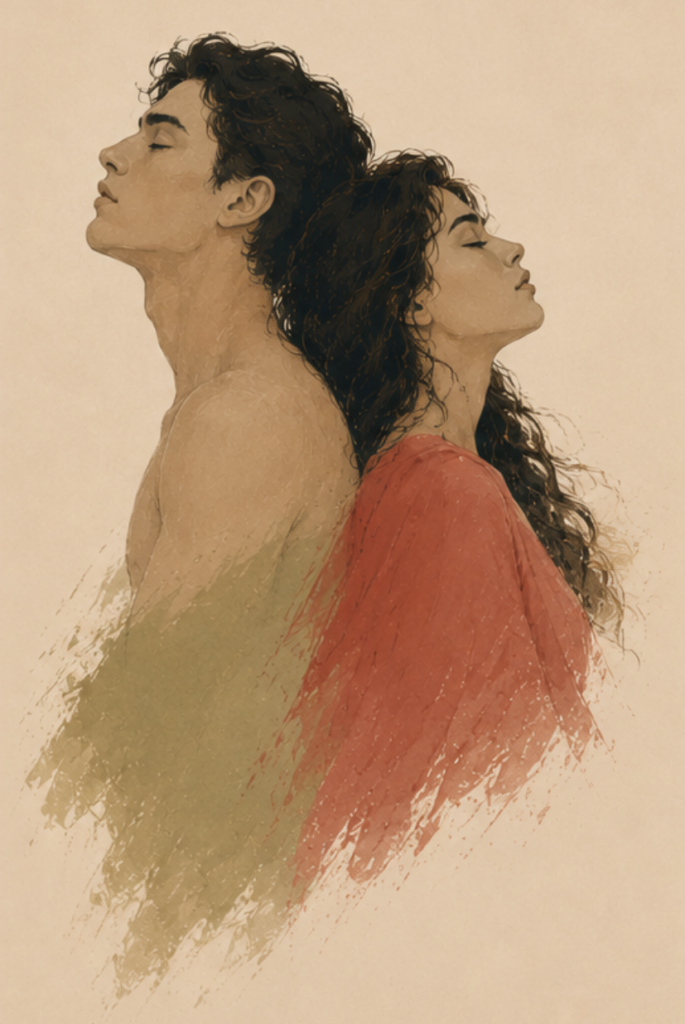
Visuals created with AI, guided by the author’s creative vision.